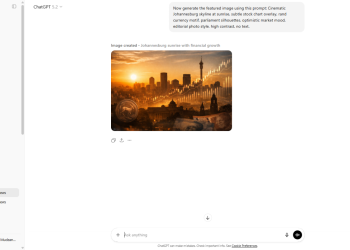

Cape Town and Johannesburg, 25 February 2026 — South Africa’s business landscape shifted into sharper focus today as the 2026 National Budget landed with a market-friendly tone, lifting the rand, equities and bonds, even as big structural issues remain front and centre: electricity pricing, logistics capacity, and the resilience of the mining sector.
Investors have been looking for one thing above all: evidence that the country can stabilise public finances while accelerating reforms that unlock growth. Today’s budget message appears to have offered enough of that to spark a clear, if cautious, vote of confidence from markets.
Budget 2026: A Credibility Signal Markets Wanted
The immediate reaction was telling. Following the budget, the rand strengthened, the JSE advanced, and government bonds rallied as yields moved lower, reflecting improved risk appetite and expectations of steadier fiscal management.
A key theme running through commentary is that Treasury is trying to entrench a clearer framework for fiscal discipline, including work toward a “principles-led” fiscal anchor. In a world where investors can shift capital quickly, credibility matters, and South Africa’s budget narrative increasingly revolves around keeping debt contained while building confidence that reforms are real and durable.
Debt Peak Talk Returns, But Growth is Still the Real Test
One of the headline messages from the budget cycle is that debt is projected to peak — widely cited around 78.9% of GDP — and then begin edging down over the coming years. That is significant in a country that has battled years of rising debt burdens and tightening fiscal space.
The budget’s growth expectations also improved modestly, with projections around 1.6% for 2026 in one leading report. However, the gap between “better than last year” and “fast enough to change lives” remains large. Unemployment and weak fixed investment keep the economy under pressure, which is why the reform agenda in electricity and logistics continues to matter as much as the headline fiscal numbers.
Eskom Tariffs: Relief for Balance Sheets, Pressure for Business
On the energy front, South African businesses face a familiar tension: improved stability efforts on one hand, and rising costs on the other. Nersa’s revised decision allowing higher Eskom tariff increases than previously approved — due to earlier calculation errors — means electricity costs are set to rise more sharply in April 2026 and again in April 2027 than businesses had been planning for.
For energy-intensive sectors, this feeds directly into margins. For SMEs, it raises the urgency of efficiency upgrades, operational load management, and — where feasible — alternative supply options. The larger macro question is whether tariff certainty, alongside reforms and improved operational performance, can ultimately reduce the hidden “tax” of unreliable power that has historically constrained growth.
Logistics Reform Spotlight: Transnet and the Private-Sector Push
South Africa’s export competitiveness is not only about what the country produces, but how reliably it can move goods to port. That is why the ongoing shift toward greater private participation in rail and port operations is drawing sustained business attention.
Recent developments highlight momentum around agreements and concessions intended to expand capacity, improve reliability, and rebuild confidence among exporters and investors. If these initiatives translate into measurable throughput gains, they could become one of the most growth-supportive reforms of the next few years, especially for mining and agriculture.
Mining: Market Tailwinds Meet Human and Operational Realities
Mining remains pivotal to South Africa’s fiscal and external accounts, but today’s news cycle was also a reminder that the sector carries deep operational and social risk. The tragedy at the Ekapa diamond operation in Kimberley, alongside the company’s move to file for liquidation, underscores the pressure some producers face amid a difficult global diamond market — and the potential knock-on effects for workers, communities, and local procurement chains.
For markets, mining strength can buoy indices and sentiment, but sustainable upside depends on investment, safety, logistics reliability, and consistent policy signals.
What to Watch Next
The big near-term question is whether today’s market optimism can be converted into real-economy momentum. In the weeks ahead, businesses and investors will likely focus on implementation details behind fiscal discipline commitments, how steep Eskom tariff changes filter through inflation and business costs, and measurable progress on rail and port performance as reforms advance.
Bottom line: Budget 2026 delivered a near-term confidence boost, but South Africa’s business outlook will be decided less by today’s speech and more by execution — especially on power pricing reform, logistics performance, and investment-led growth.