


While affordability pressures are hitting Americans in many facets of their lives, from groceries to gas prices to housing costs, one important expense often gets less attention – childcare.
After a huge infusion of federal funds into childcare dried up at the end of the Biden administration, experts warned that this sharp cutoff, sometimes dubbed the “childcare cliff,” would force parents to either scale back work to handle the extra caretaking or pay steep costs out of pocket.
The potential effects of the federal cuts are hard to estimate, in part because states took different approaches in the aftermath. In some cases, they offset the sharp cuts in part by redirecting other funds to childcare.
But several states, including Vermont, New Mexico and Kentucky, have gone further and innovated on their own to shore up support for working parents and their young children. Meanwhile, New York City is expanding free toddler slots for lower-income families, following Mayor Zohran Mamdani’s announcement to build a universal early childcare system.
Taken together, these experiments point to bipartisan ways to support working parents, especially if the results of the November 2026 midterms signal a new willingness to tackle one of the biggest cost burdens for families.
As researchers of sociology and childcare policy with six children from 1 to 16 years old between us, we have also gained insights from our own data gathered over 75 interviews with parents in St. Louis, Missouri, over the past few years. We see them struggling with a fragmented childcare system that’s in need of a deep strategic investment. These families face limited choices and soaring costs for an essential good that allows a parent to go to work.
Out-of-pocket expenses for parents using center-based care in childcare centers and private preschool programs have more than doubled since 2019. In 2024, the national average price of childcare was US$13,128 annually, which rivals housing as the most expensive item in family budgets.
States go their own way
The disruption caused by the COVID-19 pandemic laid bare the critical role that reliable, high-quality childcare plays for working families. But we believe it also presented an opportunity for innovative investments in the nation’s fractured childcare landscape.
Pandemic relief legislation in 2021 directed nearly $40 billion to shore up the supply and quality of childcare. This funding increase, which was a fourfold jump over previous levels, supported childcare staff with higher wages and allowed for other investments to improve the quality of care.
The reach was vast, with stabilization funds flowing to 220,000 providers serving 9.6 million children. Many states also provided grants to create new slots and improve how providers got paid.
As those funds began drying up in September 2023, some states started to address these shortfalls on their own. In some cases, they took significant steps at a policy level to channel more support to working parents. We believe these investments could serve as examples for the rest of the country.
One is Vermont, which in 2023 became the first state to pass a law establishing a childcare entitlement. Following more than a decade of advocacy and bipartisan support, the law established a near-universal public childcare system, funded partially through a payroll tax of 0.44% split between employers and employees.
Through an expansion of subsidies along income tiers, the number of families covered rose by 55% from July 2022 to May 2025, while flexible grants increased the number of providers and focused on improving the quality of care. About 12,000 children are now covered under this program.
New Mexico went even further. In November 2025, the state became the first in the nation to offer universal childcare. Based on an older program that provided free childcare to low-income families, the initiative expanded support to all working parents regardless of income.
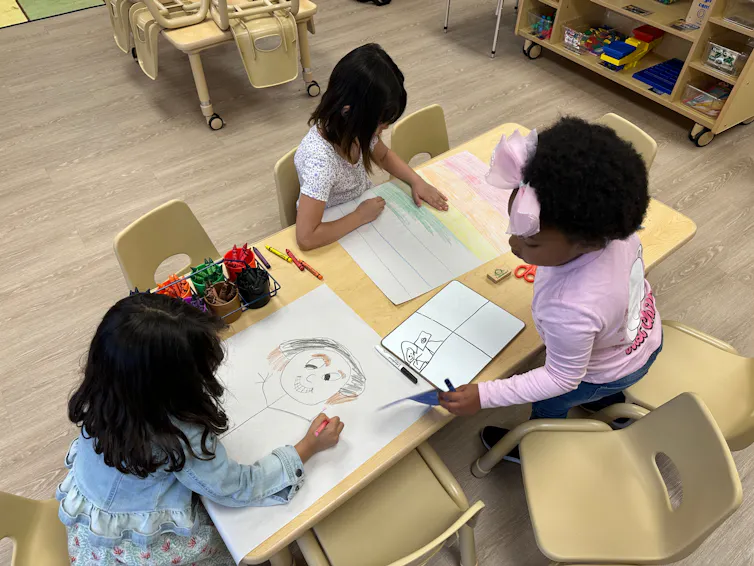
AP Photo/Susan Montoya Bryan
Before the expansion, 32,000 children were covered, a number the state aims to double by 2028. On average, the state estimates that the program will save families $12,000 a year.
Meanwhile, the Kentucky legislature in April 2026 passed a measure with strong bipartisan support to make major investments in the state’s childcare infrastructure. Key provisions include free childcare for the children of childcare center employees, increased state-subsidized reimbursement rates, and required training to support very young special needs children.
The Kentucky measure also loosened regulations that had made it tough for employers to share costs for care, such as renting facilities, while pitching a pilot program to open one-room “microcenters” in communities that lacked sufficient childcare options. In addition, Gov. Andy Beshear launched a complementary Pre-K for All pilot program in several counties.
Another example is New York City, where Mamdani has announced an expansion for toddlers as young as 2 years old in all five of the city’s boroughs, building on the city’s programs for free childcare for 3-K and pre-K. To date, this effort has increased some slots, although the rollout in September hit bumps.
The childcare crunch by the numbers
Given the skyrocketing costs, over 70% of families who sought care say it’s difficult to find childcare – and that doesn’t count the 11% who fail to find any at all, according to a 2023 government survey. That report found that families with Black or Hispanic children or infants, and those living in the South and West, are more likely to run into cost as a barrier.
On the supply side, three-quarters of providers say they have to turn many families away or put them on waiting lists. Center-based care for an infant costs more than in-state college tuition at a public university in 32 states, yet childcare workers, who are overwhelmingly women of color, earn the same as parking lot attendants and dog walkers. That makes them some of the lowest-paid workers in the entire economy.
Amid soaring costs and scarce supply, roughly half of all U.S. families live in so-called childcare deserts – areas where there are three children under 5 for every licensed-care slot. The answer for many families in these cases is to rely on ad hoc and irregular informal care. Some parents told us they’re turning to relatives and neighbors for help. Others resorted to using unlicensed, and potentially unsafe, childcare providers because they found no other viable options. And for some remote workers, the daunting solution is to care for their kids themselves while working.
The problem with such makeshift arrangements is that they tend, on average, to offer fewer of the learning opportunities linked to children’s long-term development and social mobility. And even these arrangements can be tough to afford: One single mother we interviewed told us she paid for a week’s childcare in kind with her own breast milk, which went to feed the care provider’s grandchildren. We also spoke to parents who reported choosing between childcare bills and heat, electricity or rent.
Another mom told us about a more unconventional solution. She and her husband work full time but can’t afford the childcare options in their community, so she decided to join a gym that provides free childcare while its members exercise. She brings her laptop and works, rather than working out, while her toddler plays.
These parents are scraping by in the absence of the affordable, subsidized childcare options commonplace in other countries. But this crunch is also a lose-lose proposition for the economy. The U.S. could lose as much as $290 billion per year by 2030 in forgone economic activity due to women not working or not working as much due to childcare pressures, according to the consultancy BCG.
A path forward
The Trump administration has laid out its own vision. Vice President JD Vance announced in September 2026 a preliminary proposal to repurpose existing funds for childcare subsidies as a cash transfer to married parents, provided that one spouse stays home. We believe, however, this approach fails to reflect the real needs of the millions of U.S. parents who can’t pay their bills if they only get one paycheck. In fact, under the subsidy program that Vance cited, only 16% of eligible children are reached today anyway.
We believe, based on our research, that any comprehensive overhaul has four important components.
First is a robust national policy for paid family leave, which would let families make the best care decisions for newborns, infants and parents themselves rather than sprinting back to work. Paid family leave would also ease demand for scarce infant care in the market.
Second is an expansion of early childhood care and education programs. By publicly subsidizing childcare, particularly for low-income families and special needs kids, policymakers can help close the affordability gap for high-quality care.
Third is a greater investment in childcare workers. Qualified caregivers are the cornerstone of high-quality childcare. If their wages and working conditions improve, it means fewer will have to take side hustles or quit for better jobs.
Finally, providers will need more incentives to open in underserved areas. Childcare is expensive to provide and runs on thin margins. In low-income and rural areas, many families can’t pay prices that cover the true cost of care, and subsidy payments are often set below that cost. So opening a center there doesn’t make much financial sense. Startup grants, higher subsidy rates and operating support help close that gap, which makes it possible to open and stay open where need is greatest.

Caitlyn Collins receives funding from Pivotal, Arnold Ventures, and the Weidenbaum Center on the Economy, Government, and Public Policy at Washington University in St. Louis. She is affiliated with the American Sociological Association, Work and Family Researchers Network, and Council on Contemporary Families.
Chloe Gibbs currently receives research funding from Arnold Ventures and Pivotal. She previously served with the President's Council of Economic Advisers from 2022-23 with fellowship support from the Federation of American Scientists.