
Foot and mouth disease is common in South Africa’s wildlife reserves. There are constant efforts to make sure it doesn’t spread to farmed animals. But since 2019 the country has seen repeated outbreaks on farms. In 2026 the country’s R80 billion (US$5 billion) beef industry faced a crisis as unchecked outbreaks spread to all provinces. This caused a 26% drop in exports of beef in 2025, heavily affecting trade with China in particular. The lack of a mandatory, nationwide system to trace diseases like this means they can’t be effectively managed. We asked Tania Prinsloo, who has researched disease surveillance systems, to explain what’s gone wrong.
How bad is the foot and mouth outbreak in South Africa?
There have consistently been sporadic foot and mouth disease outbreaks in the country. But the most recent outbreak of the SAT2 strain started in May 2021 in the province of KwaZulu-Natal . Foot and mouth disease has spread to all provinces, with clusters of confirmed outbreaks in different regions.
A January 2026 study by the Bureau for Food and Agricultural Policy estimated that South Africa’s current outbreak could cost the livestock sector R13.1 billion over the next five years. This includes R11.3 billion in lost production value and R1.8 billion in lost export revenue.
Between 2019 and 2025, three outbreaks resulted in R821 million in export losses. This figure was projected to rise to R2.6 billion by the end of 2026.
Since January 2025, key export markets, including China, Mozambique, Zimbabwe, Namibia and the United Kingdom, have remained closed to South African beef exports.
Foot and mouth disease affects cloven-hoofed animals. It is highly contagious. There are vaccines available, and the country has continuously imported vaccines, with massive campaign drives from the start of 2026.
The disease is often transferred from wildlife to domestic animals such as sheep, pigs and cattle. It spreads through contaminated animals, animal products, equipment, vehicles, human activity, and even windborne viruses. Clinical signs include blisters on the lips, tongue, palate, gums, nose, coronary band, and between the hooves.
Foot and mouth disease poses little risk to human health. But it has significant economic effects due to livestock losses, reduced productivity, and the high costs of disease control. Meat and dairy products are safe for human consumption, and the disease does not get transferred to humans. There is a common misperception: foot and mouth disease should not be confused with hand, foot and mouth disease, a common childhood illness. The two diseases are caused by different viruses.
Wildlife and livestock interactions are particularly high along the borders of protected areas like the Kruger National Park. Fallen or broken veterinary fences allow wildlife – which naturally carries the foot and mouth disease – to wander into community grazing lands, making it very difficult to prevent the spread.
Common control measures include movement restrictions, quarantines, culling of infected and exposed animals, and the cleaning and disinfection of affected facilities, vehicles and equipment.
What are traceability systems?
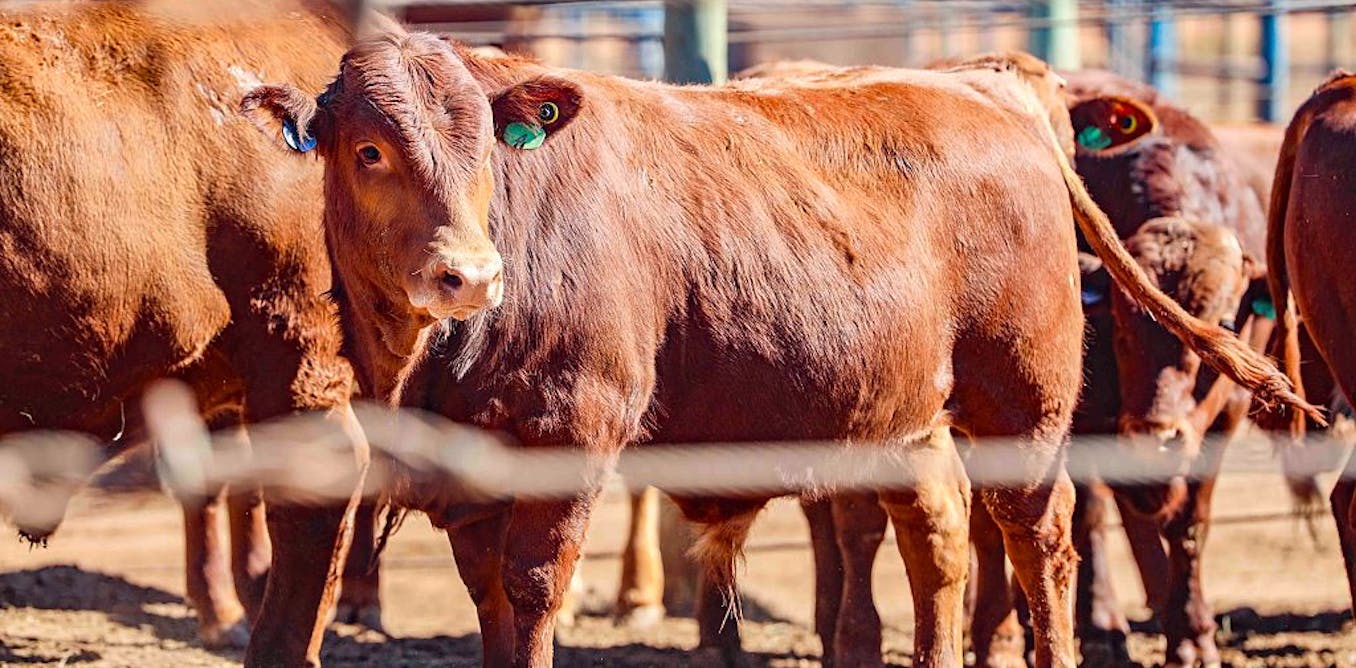
Livestock traceability systems are used to track food products, animals and related substances throughout the production, processing and distribution chain. They produce an accurate record of every animal throughout its lifetime, including vaccination, movement and the destination of the meat after slaughter. The animal is also uniquely identifiable according to its ear tag number.
In disease outbreaks traceability systems would play a key role in managing their spread. The only traceability system currently used widely in South Africa is from the Red Meat Industry Services. But participation is voluntary.
Livestock traceability systems identify an infected animal, which other animals it came into contact with, where water areas were shared, and which animals grazed together. This enables the quarantine of all possible infected animals, preventing any further spread of the disease.
Global markets are increasingly requiring national levels of livestock traceability. South Africa has a target for implementing one by 2030.
How functional are they in South Africa?
South Africa does not have a country-wide traceability system. There are groups of farmers who have created their own traceability systems. Karan Beef, one of the country’s leading beef producers, has stated that it would only buy animals that could be individually identified and fully traced. In addition, the farm of origin had to be registered on the Red Meat Industry Services platform and have a valid Global Location Number.
Its efforts were rewarded in June when it announced it was resuming exports after more than a year of disruptions caused by foot and mouth disease.
But the largest part of the South African beef market remains locked out.
The Red Meat Industry Services has created a traceability system that is gaining traction. This is a large industry role-player that encompasses the full value chain, including livestock producers, feedlots, auction houses, abattoirs, processors, marketers and exporters. It is the only organisation mandated to implement the Red Meat Industry Strategy 2030 on behalf of this entire sector.
But several challenges prevent South Africa from making a country-wide traceability system mandatory:
-
The Department of Agriculture, Land Reform and Rural Development faces budget constraints, staff shortages and service delivery challenges. This makes nationwide enforcement difficult.
-
Agriculture is the responsibility of the provincial governments, according to the country’s constitution. So nine provincial administrations and one national one would have to work together to create a viable system. In 2017 the national government assigned the task of developing a system to the Council for Scientific and Industrial Research. But the project has lost traction.
-
The differences between commercial farmers and emerging, small-scale farmers make it difficult to have one traceability system that caters to all. Small-scale farmers have limited access to farmland, credit and other essential resources, and lack the newest technologies.
-
Many commercial farmers have invested in their own traceability systems, using their own technologies and infrastructure. It’s difficult and costly to integrate their data into a single central place.
What needs to happen to fix them?
The South African government is responsible for regulatory oversight, policy enforcement and disease surveillance to ensure food safety, combat livestock theft, and unlock export markets.
It has public-private partnerships such as the red meat industry platform and compliance tracking protocols that satisfy strict European Union and global import requirements.
A nationwide mandatory traceability system is vital for South Africa’s economic and agricultural future. A drive is needed to encourage farmers to develop and adopt innovative technologies by increasing their knowledge of available digital solutions, addressing affordability issues and improving internet infrastructure.
If a traceability system is implemented, every animal must be fitted with an ear tag containing a unique number. But the tags are expensive.
Neighbouring Eswatini implemented its traceability system in 2012 and made it mandatory in 2013. Communal farmers’ tags were subsidised. But Eswatini is a small country. In South Africa, the number of animals requiring free or subsidised tags is high. There are roughly 2.4 million small-scale farmers.
Still, South Africa cannot afford to wait. Access to global markets will continue to decrease if the disease is not brought under control.
Paballo Phakoe, business application junior specialist at the Auditor General of South Africa and master’s student in the Department of Applied Information Systems at the University of Johannesburg, contributed to this article.

Tania Prinsloo does not work for, consult, own shares in or receive funding from any company or organisation that would benefit from this article, and has disclosed no relevant affiliations beyond their academic appointment.